

Beyond the Impulsive Approximation: The Dynamics and Radio Emission of Tidal Disruption
ApJL, in press
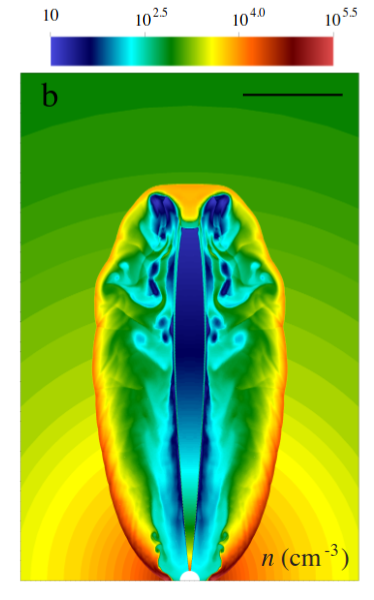
Relativistic tidal disruption event jets are powered by fallback accretion over weeks to months, rather than by a single impulsive explosion. Using relativistic hydrodynamic simulations coupled to synchrotron radiation calculations, we show that sustained energy injection produces slower shocks and substantially fainter radio emission than predicted by the standard impulsive approximation.
Slower and fainter. Fallback-powered jets produce slower forward shocks and delayed, systematically weaker radio emission.
The impulsive approximation breaks down. It is valid only when energy injection lasts less than roughly 10% of the deceleration time.
Off-axis emission is strongly suppressed. Sustained jets are less beamed, suggesting that relativistic jets in TDEs may be more common than radio observations imply.